
I was captivated by a page in Hilda Johnson’s book, Bygone Days on the Tamar, that spoke of 19th Century graffiti. Although I frequent the Supply River, I’d never encountered such historical markings.

Despite uncovering references to the graffiti online, a photograph, part from the one in Johnson’s book, remained elusive. My determination to find this engraving led to several attempts. The first, during autumn, was thwarted by the strongly flowing river and slippery algae-covered rocks. Undeterred, I returned in the summer, experiencing my own Indiana Jones moment when I stumbled upon Adolarius Humphrey’s 19th-century equivalent of ‘I was here’, etched deeply into the rock – ‘AH 1804’.

But who was Adolarius Humphrey? And why exactly was he going around carving up our rocks in 1804?
Adolarius William Henry Humphrey
Adolarius William Henry Humphrey was born in London to George and Sarah in 1782. George Humphrey was a natural history dealer, as well as being a student of conchology (the study of shells). An interest in the natural world was fashionable at the time, and George was successful in his field.

Through his involvement in the natural history world, George became acquainted with Charles Greville, a gentleman amateur naturalist. No doubt Greville would have met young Adolarius. When a Minerologist was sought for a journey to Port Phillip (Victoria), Greville recommended Adolarius as the man for the job. It is perplexing to try and understand this recommendation. Adolarius was only 20 years of age at the time, and his level of qualification for the role is unclear. Regardless, Adolarius accepted the role and in due course set sail for the antipodes.
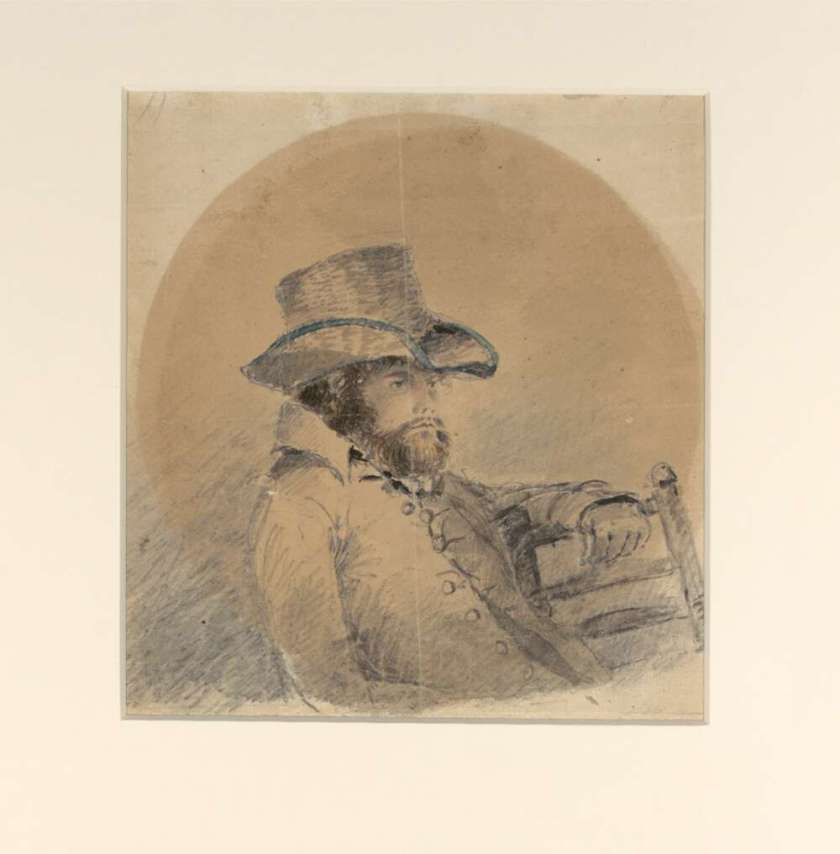
The Journey to the Supply River, Van Diemen’s Land
Humphrey doesn’t appear to have been a natural seaman. His letters indicate he suffered regularly with sea sickness. Eventually though, the ship arrived in Port Phillip. Whilst there he learned that two of his shipmates were proceeding onwards to complete a survey of Van Diemen’s Land, and he was successful in his application to join them.
The crew travelled down the Tamar River as far as the Cataract Gorge. Travelling back upriver, a stop was made at a river, the Supply, to re-fill water casks. It was here that Humphrey, to idle time, took a hammer and chisel and left his mark on the rocks.
In his own words –
On the morning of the 13th we went on shore to examine a waterfall which one of the seamen had seen the night before when in search of kangaroo. We found it excellent water and filled several casks at it. Whilst this was doing I amused myself with carving my name [A.H. 1804] in the solid Basaltic rock with hammer and chisel, in a place where it must be seen by any boat’s crew that may hereafter visit the spot for fresh water.
Adolarius William Henry Humphrey
The journey around Van Diemen’s Land continued and Humphrey witnessed the founding of Hobart Town (assisting with the construction of the first house by Europeans) and ascended Table Mountain.
Afterwards
Humphrey had regular mentions in the Colonial Secretary’s correspondence. This included land grants, appointment as a Magistrate and Justice of the Peace, and being granted a ration (a 1/2 pipe of port wine and 24 dozen bottles).
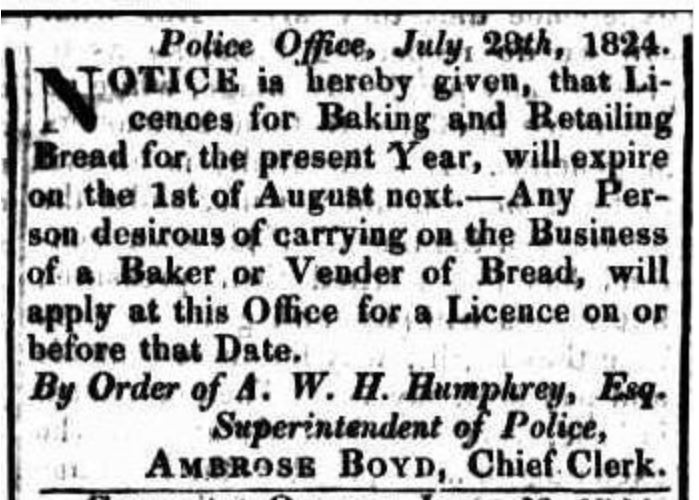
Information about Humphrey’s life can be further gleaned from the newspapers of the time. This includes a period where he was Superintendent of Police, and followed up such matters such as issuing licences for the baking and retailing of bread. In 1822, Humphrey was a founding member of an Agricultural Society for which he was Vice-President.
Most interesting though (at least, to me) was Colonial Secretarial correspondence in 1811 requesting Humphrey return Harriet Sutton to her parents. Reports in the newspapers of the time suggested that Humphrey seduced Harriet away from her parents in 1806. Humphrey was in New South Wales at this time, however returned to Van Diemen’s Land in 1807 for another minerological study which led to discovery of salt pans near Tunbridge. Harriet managed to evade her parents to travel to Van Diemen’s Land to be with Humphrey yet again. Humphrey ignored the request to return Harriet to her parents, and in 1812 they married. Governor Macquarie hadn’t supported Humphrey’s permanent appointment as Magistrate given his apparent disregard for the law in this matter.

Also of interest in Humphrey’s life is that his property at Pittwater was attacked by outlaw Michael Howe. Howe had hoped to find Humphrey at home, no doubt seeking some colonial justice for decisions Humphrey made on the bench. With Humphrey being away, however, Howe and friends ransacked the house destroying all they could find instead.
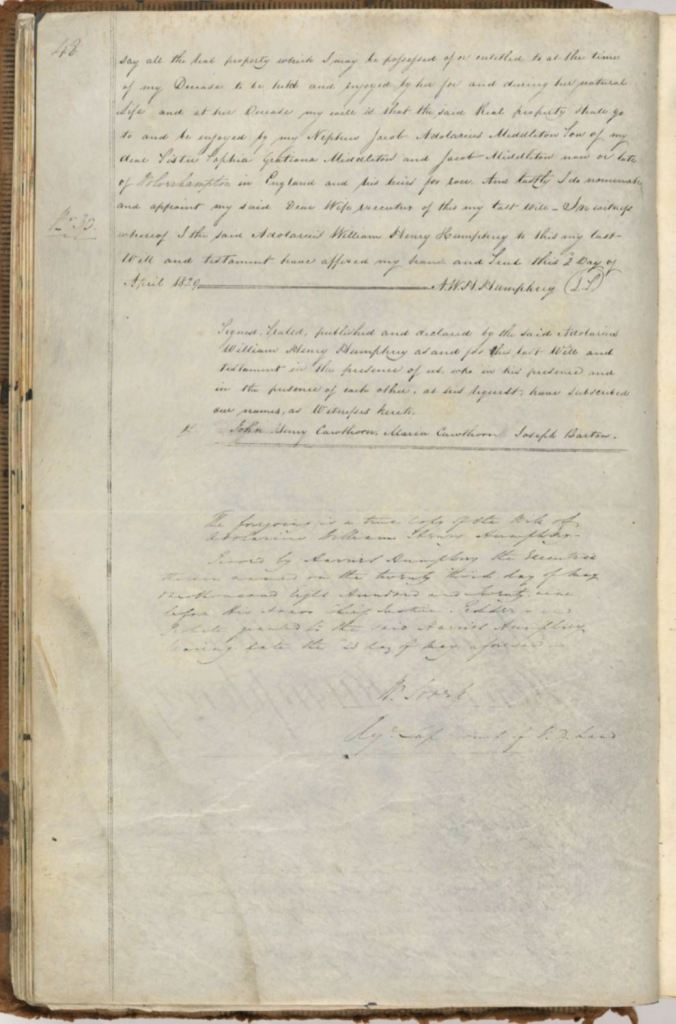
Humphrey retired in 1828, at a young age, due to ill health. By this time, he was living on his estate, which he modestly named ‘Humphreyville’, which is the area we now know as Bushy Park. He died a year later in 1829 at the age of 47 years, survived by Harriet. They had no children. Humphrey’s Will named Harriet as his beneficiary for the term of her life. Upon her death, Humphrey’s estate was to be transferred to his sister Sophie’s son, Jacob Adolarius Middleton.


Conclusion
In summary, finding Adolarius Humphrey’s graffiti at Supply River is a tangible link to the past, offering insight into the life of a 19th-century explorer. While these carvings may appear to be simple marks on stone, they still captivate our interest in history, proving that even the most unassuming rocks can hold a remarkable story.
Further Reading
To read more of Humphrey’s travels in Port Phillip and Van Diemen’s Land in 1803-4, I recommend A Voyage to Port Phillip and Van Diemen’s Land with Governor Collins by A.W.H Humphrey. This narrative is constructed from Humphrey’s letters to his family at the time.
You can read Hilda Archer Johnson’s memories of the Supply River in Bygone Days on the Tamar.
Terry Newman authored the 2004 paper Tasmanian Graffiti: Humphrey’s ‘Hammer and Chisel’, 13 January 1804. This is well worth a read for a deeper look into Humphrey’s life and the historical context in which Humphrey chiselled his name into the basalt.
Sources
Colonial Secretary Correspondence, Ancestry
Colonial Times, 15 May 1829, p.4
G. H. Stancombe, ‘Humphrey, Adolarius William Henry (1782–1829)’, Australian Dictionary of Biography, National Centre of Biography, Australian National University, https://adb.anu.edu.au/biography/humphrey-adolarius-william-henry-2212/text2871, published first in hardcopy 1966, accessed online 16 January 2022.
Hobart Town Courier, 16 May 1829, p.2
Hobart Town Gazette, 21 April 1827, p.1
Hobart Town Gazette, 8 August 1829, p.5
Hobart Town Gazette and Van Diemen’s Land Advertiser, 26 January 1822, p.1
Hobart Town Gazette and Van Diemen’s Land Advertiser, 30 July 1824, p.1
Humphrey, AWH (2008), A Voyage to Port Phillip and Van Diemen’s Land with Governor Collins, Colony Press, Malvern.
Johnson, Hila Archer (1998), Bygone Days on the Tamar, Regal Press Publications, Launceston.
Sydney Gazette, 27 Apr 1806, p. 4
Sydney Gazette, 18 May 1806, p. 4
Sydney Gazette, 8 Jun 1806, p. 1


 Tamar Valley Tales
Leave a comment