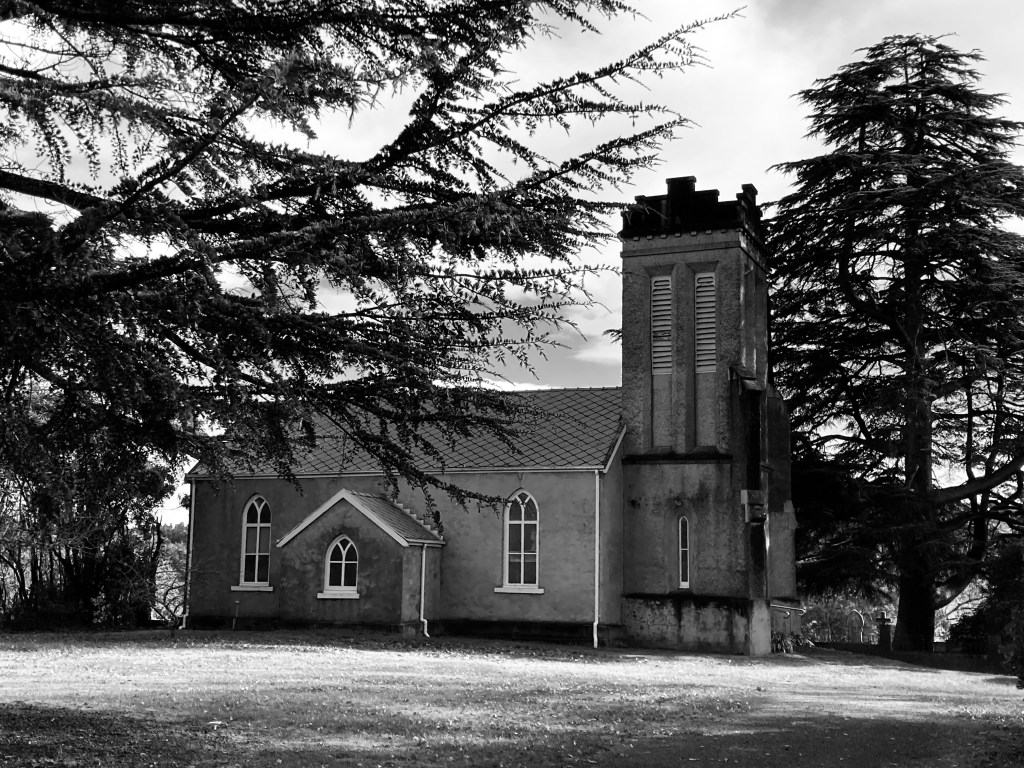
Content Warning: This historical blog post contains graphic details related to murder and execution by hanging. Reader discretion is advised
The Ghost of the Westbury Road
In the eerie twilight of May 1873, as the days waned and shadows stretched long, a weary traveller was journeying home through the quiet countryside. He pressed on as he passed the site where Mrs Regan met her tragic demise, despite the ghostly tales that haunted his thoughts.
Yet, as the oppressive silence of the night enveloped him, strange and unsettling sounds began to echo through the stillness. The traveller could feel his heart pounding in his chest, as he turned his gaze toward the darkness of the Sillwood Road, where the unsettling noises seemed to come from.
There, amidst the gloom, a spectral apparition materialised before his very eyes. Clad in ethereal white, its form initially appeared monstrous, akin to some otherworldly dromedary from the depths of nightmares. With a spine-chilling rumble, it unfurled two colossal wings, billowing like ghostly sails.
As the phantom creature drew nearer, a desperate cry pierced the silence. “Kill him, Choker, kill him”. Breathless with fear, the traveller sought refuge behind a looming oak, as the ghostly creature approached.
As the ghostly presence swept past, the monstrous form began to shift, assuming a semblance of humanity while keeping its imposing stature. Two spectral hounds accompanied it, the larger of the two giving chase to its diminutive counterpart, the trio forging ahead.
With spectral hounds in relentless pursuit, the eerie procession vanished into the shadows of Oaks Road, leaving behind only whispers of their haunting presence.
Emma Lynam Marries
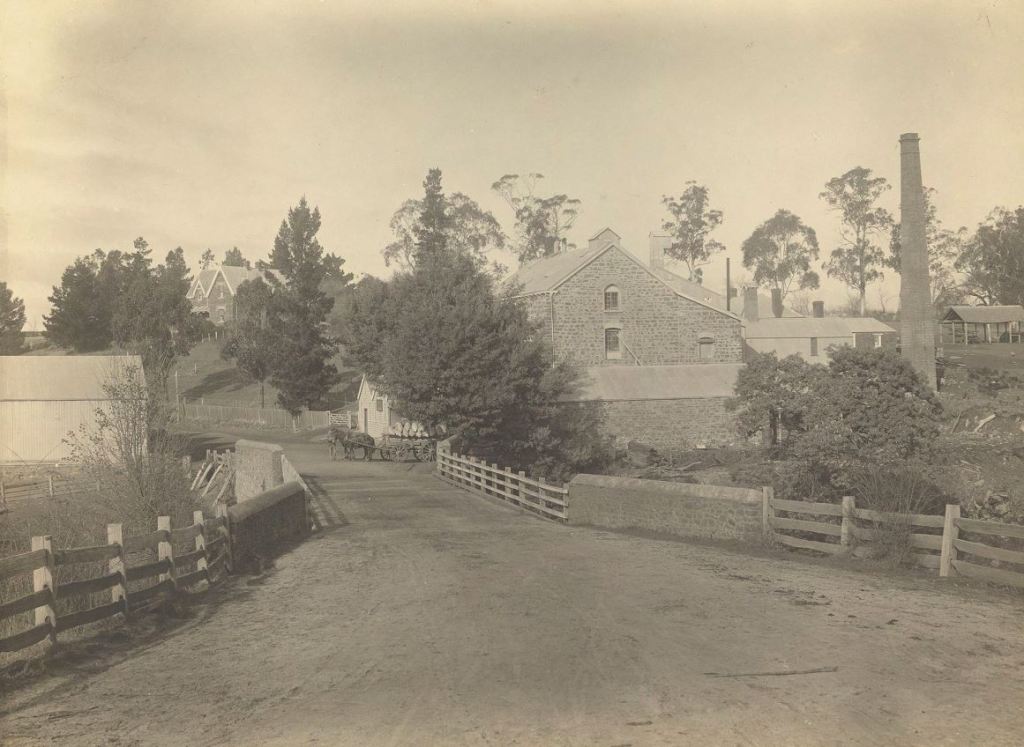
The town of Carrick, with its heritage buildings lining the main road, evokes images of earlier times. Once over the bridge, the road transforms into an old highway, now replaced by modern routes. With farmland on either side and no streetlights, it’s possible to envision the events of 1870 that led to Emma Regan’s tragic death.
Emma Lynam’s childhood wasn’t easy. She and her sisters spent a period being supported by the Queen’s Orphan School when both parents were incarcerated. The girls returned to live with their mother in Westbury following her release.
John Regan, a railway worker, boarded with the Lynams in Westbury. Regan was Irish born. He’d been convicted at Limerick during the potato famine for stealing wheat and oats and was transported to Tasmania.
![A section of John Regan's Conduct Record. It includes his transportable offence and a physical description of him. [TAHO].](https://tamarvalleytales.com/wp-content/uploads/2024/02/john-regan-conduct-record.jpg?w=1024)
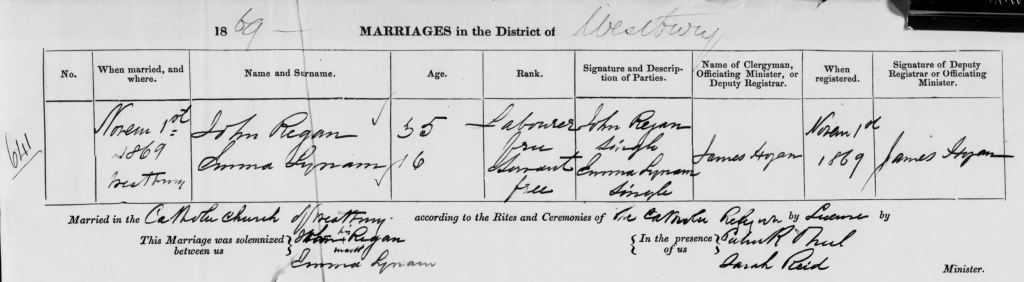
Emma married him at the young age of sixteen years. The marriage certificate from 1869 records Regan’s age as 35 years. He was likely older, given his age was recorded to be 23 years when convicted in Ireland in 1847.
The Day Emma Regan Died
John, Emma, and Emma’s mother and sister had been planning to move to Melbourne. Perhaps it was this that led to John needing to travel to Launceston to withdraw money in March 1870. Emma and her sister Ellen went with him on the journey. The couple had been married for five months at this time.
The day began without sign of the tragedy that would unfold. They dined in Launceston with a relative of Regan’s, and after lunch Regan bought Emma a cloak and earrings, and bought two shillings worth of sausages. It was an uneventful day.
Around 4 o’clock, the party returned to their borrowed cart and began the journey home. It was dark by the time they reached Carrick, where they stopped at Mrs. Fogerty’s inn. Emma and Ellen sat together in the back of the cart, opposite each other. Through the inn windows, they could see Regan, who drank two glasses of spirits. At one point he brought a glass of spirits out to Emma, and a ginger beer for Ellen.
![Old photograph showing buildings along the main street in Carrick Tasmania [TAHO].](https://tamarvalleytales.com/wp-content/uploads/2024/02/main-street-carrick-taho.jpg?w=1024)
After about 20 minutes, they resumed their journey. Regan asked Ellen to take the reins, while he sat in the back with Emma. Emma began to sing as they travelled.
By this time, it was around 8:30 pm, and they were traveling through Ashburner’s Forest, a heavily timbered area through which the Westbury Road passed, about a half-mile on the Launceston side of the Sillwood toll gate. Regan began arguing with Emma.
Regan accused Emma of squandering his money by buying a dress and hat for her mother. Emma replied, “What odds?” Regan then stood up and struck her in the face. He grabbed Emma by the neck, kicked her, and threw her onto her back.
Regan then opened a penknife and brutally attacked his wife. He stabbed her seven times in the neck, with one of the wounds below her left ear leading to her death.
Ellen Lynam Seeks Help
Ellen, only a young girl of eleven or twelve years, found herself in a terrifying situation. Fearing for her safety, she leapt from the cart and fled, with Regan in pursuit. After a brief chase, Regan disappeared into the darkness of the bushland.
![Black and white photograph of the old Sillwood homestead, near Carrick in northern Tasmania [TAHO].](https://tamarvalleytales.com/wp-content/uploads/2024/02/sillwood-carrick-tasmania-taho.jpg?w=1024)
Once she was certain that Regan was gone, Ellen took control of the horse and cart, with her sister still in the back, and made her way to the Sillwood tollgate. Upon arrival, she called out for help, informing Mrs. Roberts, the wife of the tollkeeper, that a murder had been committed.
Man-Hunt for John Regan
The search for John Regan began after he fled the scene. Witnesses reported seeing a man in a hurry near the Entally tollhouse, heading towards Prospect Village.
Regan managed to evade capture for around a week when he surrendered himself to Father Walsh. Father Walsh handed Regan over to the police, saying “Regan has given himself up, and I leave him with you.”
Police searched a paddock on Wellington Street, where Regan was said to have hidde. There they located the murder weapon, apples, pears, and a winnowing machine hidden under straw. A number of people had been providing him with food.
The Trial of John Regan
The trial was a sombre affair . Witnesses provided varying accounts of Regan’s character, with some describing him as a jealous man with a history of violence under the influence of alcohol. The jury heard that Regan had drank ale whilst lunching with his relative and had then consumed spirits on the return journey.
It is difficult while looking at the mild inoffensive little man, to imagine how he could have been wrought up into the frenzy, which resulted in the horrible murder of his wife.
Cornwall Chronicle, 15 April 1870, p.2
Evidence presented during the trial shed light on Regan’s background, including his earlier living arrangements and relationships. Regan had lived in a wooden structure opposite Mr. Beveridge’s workshop on Wellington Street in Launceston, where he had a woman and several children living with him. It was unclear what became of the younger children, but one boy was taken in by Mrs. Prior of Wellington Street. Regan later became acquainted with Mrs. Lynam and her three daughters, including Emma, whom he married five months prior to the murder.

It was reported that Mrs. Lynam had locked up Regan’s belongings and demanded he marry Emma before they would be returned. We can only conjecture about the reasons why a mother may have demanded a man in her household marry her teenage daughter.
Defence witnesses testified to the strained relationship between Regan and his wife, with some suggesting that Emma had provoked him. Regan had previously been to the police about a man named Clancy, from whom Emma had received a ribbon on Valentine’s Day. It was said that Clancy had been visiting Emma in Regan’s absence, and that Regan had found the two in compromising circumstances.
The prosecution shared that Regan had bought a knife, just like the one he used to murder Emma, at Mr. Barker’s store in Westbury the night before the murder.
The judge rejected the attempts by the defence to claim provocation by Emma, instructing the jury to consider between murder and manslaughter, given Regan had killed in great brutality with no provocation.
The jury retired for an hour before returning a verdict that Regan was guilty of murder. He was sentenced to death without the hope of mercy.
After the verdict was read, John Regan looked back from the dock and said, “Tell Mr and Mrs Prior to take care of my poor boy”.
The Day John Regan Died
On June 28, 1870, John Regan faced his final day in a cell at Launceston Gaol. The weather was overcast, with steady drizzle adding to the subdued atmosphere. Father Walsh, who had been providing spiritual guidance to Regan since his surrender, remained by his side throughout the night and into the morning. Officials and spectators watched as Regan was led from his cell, arms bound, to where the drop had been erected.
![Plaque at the site of the gallows associated with the Launceston Gaol. Plaque is on the grounds of Launceston College, Paterson Street. [Photo by author].](https://tamarvalleytales.com/wp-content/uploads/2024/02/img_0416-1-1.jpg?w=768)
Regan, dressed in a white shirt, trousers, and vest walked up the steps to the drop. Father Walsh was praying with Regan. As a white cape was placed over his head and a noose around his neck, Regan continued to pray. When the drop fell, Regan’s body was left hanging, his neck dislocated. He struggled for twelve minutes before succumbing to death.
A coffin bearing the inscription “John Regan, Died June 28, 1870, aged 46 years” was provided by relatives and left the Launceston Gaol at 3pm. Regan was interred in the Roman Catholic Cemetery next to his daughter from his first marriage.
Conclusion
The tale of Emma Lynam is a sorrowful one, a young life cut short by the violence of another. Perhaps it is her spirit that wanders the Oaks Road at night, seeking solace.
However, it was not her that our weary traveller met, as there was a different explanation.
On that same night, at the same hour, Mr. Gillam of Sillwood was roused by a commotion from his chickens. Without hesitation, he and his dog pursued the creature that had disturbed them along the Oaks Road. Gillam was still wearing his nightdress at the time. The dog apprehended and dispatched a large tiger cat (spotted quoll). It was this scene that our traveller, overcome with dread, mistook for something monstruous and otherworldly.
Interested in More Ghost Stories?
If this haunting caught your interest, you’ll find more Tasmanian ghost stories gathered on our Ghosts of Tasmania page.
If You Need Support
If you or someone you know needs support, please contact any of these organisations for assistance. If you are concerned for your safety or the safety of others, call Triple Zero 000.
- Lifeline: Lifeline provides 24/7 crisis support and can be reached at 13 11 14 for immediate assistance.
- Beyond Blue: Beyond Blue offers support for mental health and wellbeing. You can contact them at 1300 22 4636.
- Your GP: If you have ongoing concerns about your mental health, please consult with your general practitioner.
Sources
A Ghost Story: From a Correspondent, Weekly Examiner, 24 May 1873, p.13.
Brutal Murder Near Carrick, Launceston Examiner, 31 March 1870, p.3.
Conduct Record and Description List of John Regan [TAHO].
Execution of John Regan, Cornwall Chronicle, 2 July 1870, p.3.
Marriage Record of Emma Lynam and John Regan (TAHO].
Queen’s Orphan School Record for Catherine, Emma and Ellen Lynam [TAHO].
Seventh Day: The Silwood Murder, Cornwall Chronicle, 11 June 1870, p. 12.
Shocking Murder Near Silwood, Cornwall Chronicle, 22 April 1870, p.3.
The Launceston Times, Cornwall Chronicle, 15 April 1870, p.2.
The Sillwood Murder, Cornwall Chronicle, 1 April 1870, p2.
The Silwood Murder, Cornwall Chronicle, 9 April 1870, p. 3.
The Sillwood Murder, Brisbane Chronicle, 18 June 1870, p.6.
The Sillwood Murder, Manaro Mercury and Coomba and Bombara Advertiser, 25 June 1870.
The Sillwood Murder: Inquest on the Body, Launceston Examiner, 2 April 1870, p.5.
The Sillwood Murder: Surrender of Regan, Launceston Examiner, 9 April 1870, p.5.
The Westbury Ghost, Tasmanian Tribune, 24 May 1873, p.2.

 Tamar Valley Tales
Leave a comment