
📍Launceston and Hobart, Tasmania
The skirt crackled when the nurses lifted it. At first they thought it was the old, weather worn fabric of the hawker’s clothing. But the sound was a dry papery rustle, not something you’d expect from calico or wool. One nurse pinched the hem and felt something stitched into the lining. Another fetched scissors. Slowly they unpicked the seams.
Coins fell out first, bright against the white sheets. Then notes, folded tight. The nurses were shocked by the amount of money before them. It was far more than anyone living in poverty was expected to have. And none of it, as the admission book later showed, belonged to a woman named Mary Patches.
The Hawker of Russell Street
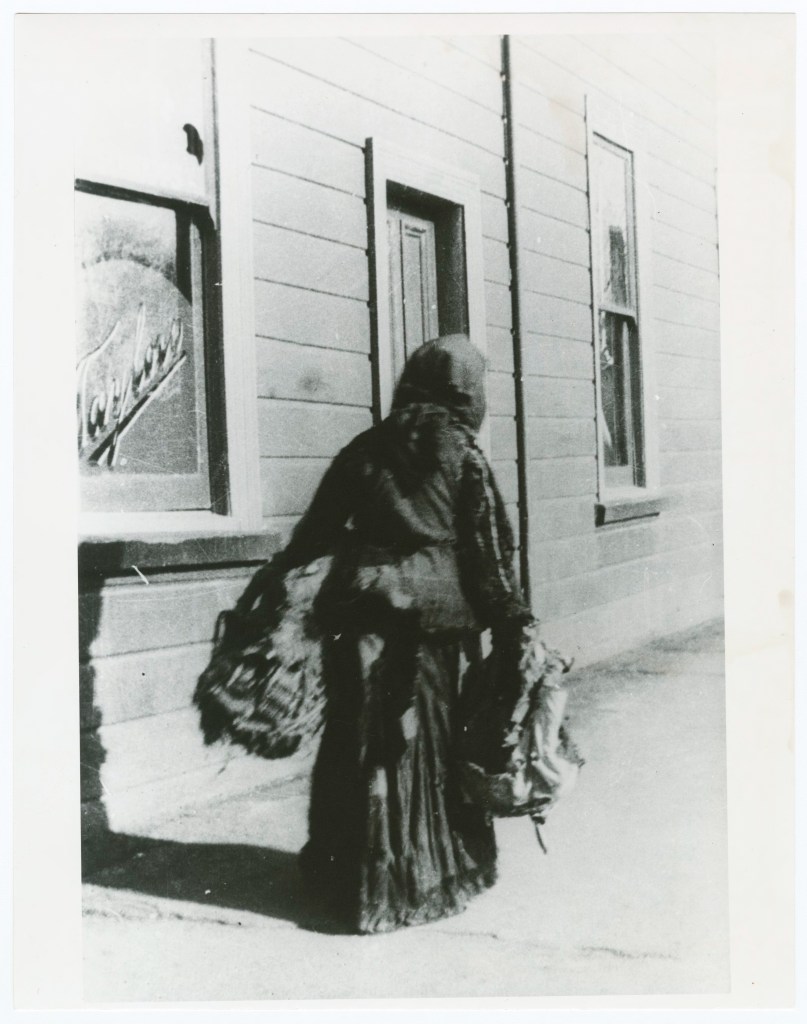
I was researching something else when I came across two photos in the Tasmanian Archives. They show a small, stooped woman wearing a heavy skirt and carrying a basket of wares near the Park Hotel in Invermay. She was named as Mary Patches.

Mary Patches lived in Russell Street and was a familiar sight as she walked door to door selling pins, cotton threads, lace, buttons, ribbons and other odds and ends. Her wares were bundled up in an old butcher’s basket tied with rope. Mary’s skirt was so distinctive that newspaper reports referred to it as though it was a character in its own right:
She wore a very full skirt covered with patches of all sizes made from cloth, canvas, blanket material, fancy cottons, and even leather.
– Daily Telegraph (Sydney), 1937
Women often invited Mary in for a feed, for which Mary was grateful but struggled to articulate in her broken English. No-one knew Mary’s past, or even her real name as it turns out, but they all remembered her skirt.
Illness and the Crackling Skirt
On 1921, Mary contracted pneumonia and was admitted to the Launceston General Hospital. It was there, according to repeated newspaper accounts, that nurses noticed a strange crackling sound whenever Mary moved.
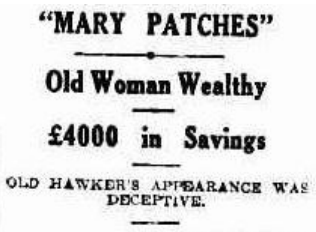
When they examined her skirt, they discovered the reason. Mary had £100 in notes sewn into one of the patches. Further inspection revealed more hidden bundles. When her skirt had been opened, the nurses were shocked by the amount of money before them. It reportedly totalled over £1,500. Even conservative of estimates place that at being around $130,000 in today’s money.
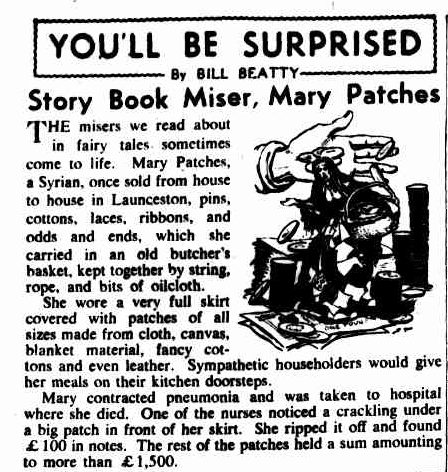
The newspapers relished the story of the ‘story book miser’, astonished at the very large sum of money Mary had sewn into the patches on her skirt.
A Name Restored
In the days that followed, officials traced her name, birthplace, marriage, and surviving family. For the first time in decades her identity was written publicly and correctly:
Her name has now been ascertained as Mrs. Assid Matta… Sowd Boolos was her maiden name.”
– Mercury, 28 August 1925
Sowd was likely a mangled attempt at spelling an unfamiliar name. Saoud is a known Levantine name.
The government took steps to transfer the money to her daughter in Syria, who was reportedly much in need. Sowd’s savings were extraordinary for a woman who had lived in deep, visible poverty. What the records don’t tell us is why the decision was made to send the money to Sowd’s daughter, and whether Sowd consented to this.
But identifying her name was only the beginning. To understand Sowd, we need to understand the world she came from.
A Stranger in a Strange Land
Most Tasmanians never met a Syrian or Assyrian migrant in the early twentieth century. Migration from the Middle East to Australia existed, but it was small, uneven, and rarely seen in places like Launceston.
Sowd had lived in Tasmania for years, but little had been recorded about her arrival. Her husband, Assid Matta, died in the New Town institution in 1921. Their son, who had been in Tasmania “some time ago,” died in Africa during the war. Her only surviving child, her daughter, was living in poor circumstances in Baskinta, Syria.
Sowd had a will prepared in 1940. When I first read it, my heart sank. An elderly woman, ill, unable to sign her own name, leaving everything to a stranger in Moonah. It felt like a familiar story of vulnerability and opportunism.
But the more I followed the trail, the more it changed. Julia Slait was no random Tasmanian widow. Her husband, Restem Slait, was a Lebanese migrant with family still in Beirut. Their names sit beside Mary’s in the same web of Levantine migration. A quiet, gentle community of hawkers, cooks, pedlars, and boarding-house keepers who arrived long before Tasmania had words for where they came from.
Instead of exploitation, what emerges is a picture of unexpected connection. Sowd, Julia and Restem were all far from home, navigating a society that often didn’t understand them. Mary spent her final years living with Julia and Restem. She was among people who shared her language, her customs, or at least the feeling of being far from home.
When Sowd passed away in 1943, Julia placed notices in newspapers mourning her death and advising of funeral arrangements. Julia expressed thanks for the condolences and flowers that had been received.
Who Were the Syrian Migrants of Early Tasmania?
Tasmania’s early records often refer to Levantine migrants simply as ‘Syrians’, but the term wasn’t used with much precision. Behind that label were people from several communities; Lebanese, Assyrian, Armenian, Maronite Christian and Chaldean Christian families arriving from different corners of the Ottoman Empire.
Quick Guide: What “Syrian” Meant in 1900s Tasmania
Syrian (in Tasmanian records) – usually Lebanese Maronite migrants.
Assyrian – a completely different ethnic group from Northern Mesopotamia.
Lebanese – often labelled ‘Syrian’ before 1920 because Lebanon didn’t yet exist.
Colonial clerks used ‘Syrian’ loosely, so the people in Tasmanian records may have been Lebanese, Assyrian, Armenian or Palestinian.
Many left the Levant because life there was becoming increasingly unstable. The late Ottoman period brought famine, land shortages, heavy taxation, and growing tension for religious minorities. Migration offered a way out of that, and Australia was actively recruiting ‘Syrian’ hawkers. Tasmania’s dispersed towns and rural districts created steady demand for travelling sellers, hotelkeepers, tinsmiths and labourers.
The migrants came speaking Arabic, Aramaic or Turkish and built their livelihoods through the jobs that were open to them. Tasmania didn’t record these migrants well, but their traces remain in hawker licences, hotel registers, court records, wills, and births of their Australian born children.
Why Sowd’s Story Matters
Sowd’s story is a reminder that Tasmania has always been more diverse than the records suggest. Migrant women often lived complex, difficult lives that were reduced to a few lines in official documents. Russell Street looks different today, but a century ago it was home to women like Sowd Boolas. Women who worked hard, built quiet routines, endured losses and were largely unseen by the systems around them. Remembering her placed her back into the city she lived in. Tasmania’s past is shaped not just by prominent names, but by people like Sowd, whose stories rarely had the chance to be told.
What We Know
- Born Saoud Boolos (sometimes spelt Sowd Boolas) in Syria. Sowd married Assid Matta.
- Sowd was known by the name ‘Mary Patches’ in Launceston.
- It’s unknown when Sowd arrived in Tasmania but it was likely prior to 1900, due to changed immigration policies in 1901.
- Assid Matta died in the New Town Charitable Institution in 1921. Their son died in Africa in WWI, and their daughter remained in Syria.
- Sowd lived in Russell Street in Invermay and was self-employed as a hawker.
- Sowd was admitted to hospital in 1921 with pneumonia. At that time, £1500 was found hidden in patches on Sowd’s skirt.
- Sowd left her estate to Julia Slait, who was part of the local Middle Eastern migrant community.
More from Tasmania’s Past
Interested in more stories of women from Tasmania’s past? You might like:
References
Examiner (Launceston), “Mary Patches”, 13 August 1925, p.4
Examiner (Launceston), “Mary Patches”, 23 October 1925, p.6.
Measuring Worth: https://www.measuringworth.com/index.php
Monsour, Anne. Undesirable Alien to Good Citizen: Syrian/Lebanese in a “White Australia”. Mashriq & Mahjar: Journal of Middle East and North African Migration Studies, vol. 3, no. 1, 2015. Project Muse.
Tasmanian Archives, Boolas, Sowd – Will No. 25558, AD960-1-67 (1943).
Tasmanian Archives, Booles, Sawd – New Town Charitable Institution, pi0153500 (1925-1933).
Tasmanian Archives, Malta, Assad – New Town Charitable Institution,
pi1107300 (1918).
Tasmanian Archives, Matta, Assad – Deaths BU 22588 (1921).
Tasmanian Archives, Matta, Assid – Naturalisation 1798189 (1903).
The Mercury (Hobart), “Family Notices”, 20 February 1943, p.9
The Mercury (Hobart), “Family Notices”, 30 March 1943, p.8
The Sydney Morning Herald, “You’ll Be Surprised”, 27 August 1947, p.3. Beatty, Bill

Researched and Written by Jodie Lee
Tamar Valley Tales
 Tamar Valley Tales
Leave a comment